Article
How Sterility Test Isolators Ensure Reliable Results?
Apr 06, 2026
Divya Daniel
Head Of Marketing
In pharma, to control quality, sterility testing is one of the most critical activities. Even a single contamination event can lead to costly investigations, delay batch release, and raise regulatory concerns. In order to minimise these risks, laboratories are increasingly relying on sterility test isolators.
A Sterility test isolator is designed to provide a fully enclosed, microbiologically controlled environment in which sterility testing can be performed with a very high level of assurance, in accordance with the expectations of regulatory authorities like the United States Pharmacopoeia, the U.S. Food and Drug Administration and the European Medicines Agency.
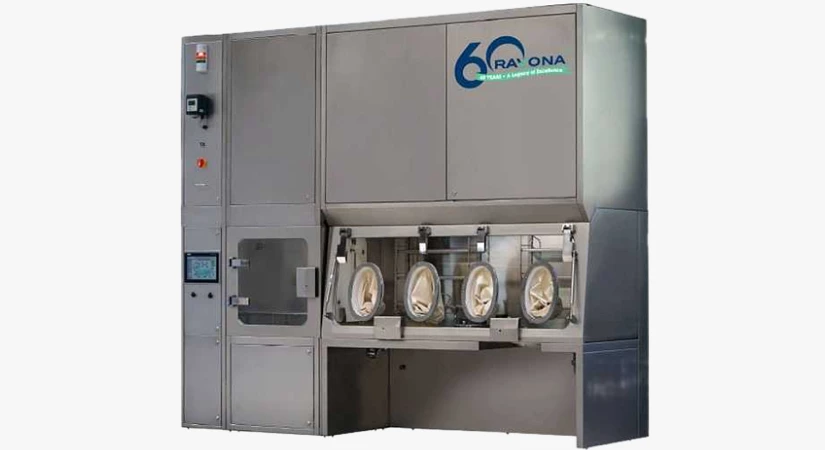
Amongst the most advanced options available today, the Ravona Pharma’s Sterility Test Isolator is the best pick for you. In this blog, we highlight how you can ensure consistent delivery, reproducibility, and regulator-ready sterility results without any compromise.
Why Environmental Control Matters in Sterility Testing
During processes such as filtration and inoculation, the test samples and culture media are directly exposed to the surrounding environment. In such scenarios, Environmental control becomes the critical foundation of sterility testing.
Even a minor environmental disturbance can affect test outcomes and compromise data reliability.
Environmental control is therefore critical for three main reasons:
1) Prevention of extraneous contamination: When the environment is controlled effectively, it reduces the number of airborne particles, microorganisms and airflow disturbances during critical processes, thereby reducing the risk of false-positive sterility test results.
2) Protection of exposed samples and media: Since the open culture media and test articles are exposed to the environment during filtration and inoculation steps, the environment needs to be well-protected via controlled airflow, pressure, and clean air quality.
3) Ensures reliable and defensible results: A stable and validated test environment allows detection of any contaminant with ease and confidence. As there is no environmental contamination, any unexpected result can be confidently attributed to the product rather than to environmental interference.
This requirement for consistent, high-level environmental control is where sterility test isolators come into the picture. As the name suggests, a Sterility Testing Isolator physically separates the test environment from external contamination sources, creating a stable, Grade A–equivalent zone for inoculation and filtration without requiring direct human intervention.
What Does a Sterility Test Isolator Do?
A sterility test isolator is an enclosed, controlled environment that eliminates external contamination risks, provides continuous HEPA-filtered airflow, supports validated decontamination cycles, limits direct human contact through glove ports, and enhances regulatory compliance documentation.
This engineered environment drastically improves the reliability of sterility test results, reduces the frequency of investigations, and makes outcomes defensible during audits.
What makes the Ravona Pharmas Sterility Test Isolator special?
The Ravona Pharma’s Sterility Test Isolator is designed to meet the evolving requirements of pharmaceutical microbiology and quality assurance operations. It integrates advanced isolator design, validated contamination control, and ergonomic process workflows to support high-integrity sterility testing, enabling laboratories to achieve enhanced data reliability, operational efficiency, and sustained regulatory compliance.
These are the Key Features that make it the ideal choice:
1. Advanced H₂O₂ Decontamination System
For reliable sterility testing, a controlled, contamination-free environment is required. Ravona isolators fulfil this requirement by integrating automated vaporised hydrogen peroxide (H₂O₂) decontamination cycles. The advanced decontamination system can effectively eradicate microbial contaminants from interior surfaces and airflow pathways. This approach ensures that each test run begins with a uniform, microbiologically controlled environment, providing confidence that any observed microbial growth is a biological signal and not an environmental contamination.
The system runs an intelligent 4-phase cycle, fully aligned with ISO 14937 (Sterilization of health care products) and the ISPE Good Practice Guide on Sterilizing Filtration of Liquids, both of which mandate validated, reproducible cycle parameters. PDA Technical Report No. 51 (Biological Indicators for Gas and Vapor-Phase Decontamination Processes) provides the scientific framework for biological indicator selection and placement, which Ravona supports with full cycle development services.
Phase 1: Dehumidification
In this phase, the internal environment is thoroughly dried to enhance H₂O₂ adsorption on surfaces. Regardless of changes in ambient humidity, the dehumidification step helps maintain consistent decontamination efficacy.
Phase 2: Conditioning
Using a precision vaporiser, H₂O₂ vapour is metered into the chamber, and a PLC maintains the target concentration, which is monitored by high-concentration sensors (100–7,000 ppm), ensuring uniform distribution through the recirculation airflow system.
Phase 3: Bio-Decontamination Hold
The target concentration is maintained throughout the validated dwell period. Biological indicators, such as Geobacillus stearothermophilus, are placed in worst-case locations to assess the process's efficacy. A minimum 6-log kill of Geobacillus stearothermophilus spores is consistently achieved.
Phase 4: Aeration
The Catalytic converters break residual H₂O₂ into water vapour and oxygen.
2H₂O₂ → 2H₂O + O₂
Low-concentration sensors (0.1–50 ppm) confirm that residual levels fall below 1 ppm before the operator is notified of safe re-entry. This protects both the sterility of subsequent tests and operator safety, in accordance with OSHA and EU Directive 2004/37/EC limits.
2. HEPA Filters
The Ravona Pharma’s Sterility Test Isolator is equipped with H14-grade HEPA filters (EN 1822 compliant) with a minimum efficiency of 99.995% for particles 0.3 µm and above. As the filter media is constructed from a PTFE membrane, it provides superior chemical resistance.
These filters are gel-sealed to prevent bypass leakage and are fitted with test connections (TC ports) for in-place DOP/PAO challenge testing and leak scans. The integrity data generated is documented as part of the IQ/OQ protocol package, providing a defensible evidence trail for regulatory inspectors.
As per EU GMP Annex 1, Clause 4.11, the integrity of the HEPA filter must be verified post-installation and at regular intervals thereafter. The Ravona platform fully supports this requirement with:
- Factory-issued HEPA filter certificates traceable to ISO 17025-accredited laboratories
- In-place DOP/PAO leak scan ports for post-installation and periodic qualification
- Automated differential pressure monitoring to detect filter degradation in real time
3. Ergonomic Glove Ports and Materials Transfer
The ergonomic glove ports and validated material transfer systems are designed to withstand automated VHP decontamination cycles, reducing human intervention and minimising unintentional disruptions to airflow. The ergonomic layout improves operator comfort while helping laboratories achieve both performance and safety.
4. ISO Class 5 Airflow Architecture
It is mandatory to maintain ISO Class 5/Grade A unidirectional laminar flow throughout the test session. The Ravona isolator achieves this via a closed-air recirculation loop, controlled by electronically adjustable blowers and continuously monitored by calibrated velocity transmitters set at 0.45 m/s ± 10%, in compliance with EU GMP Annex 1 and ISO 14644-3.
A double-layer air distribution membrane eliminates turbulence, ensuring that airflow is uniformly vertical from HEPA ceiling units to the perforated stainless steel floor. Return air passes through the catalytic converter ductwork before recirculating, a design that simultaneously maintains laminarity and degrades residual peroxide.
In line with ISPE Baseline Guide Section 5.4, which recommends continuous particle monitoring during aseptic processing, the Ravona platform integrates the IsoAir® 310P optical particle counter directly into the chamber floor, measuring 0.5–5.0 µm particles at 1 CFM and routing real-time data to the HMI and optional SCADA system.
5. Pressure Integrity: Leak Testing to ISO 10648-2
A sterility test isolator is only as reliable as its physical barrier. The Ravona system performs automated pressure decay leak testing to ISO 10648-2 Class 3, with a maximum permissible leakage rate of 2.5 × 10⁻³ mbar·L/s (0.25% per hour).
This test is executed by the Siemens S7-1500 PLC before every decontamination cycle and after any maintenance event. The test sequence of seal activation, pressurisation to +250 Pa, stabilisation, measurement, and automatic result logging requires no manual intervention and generates a fully traceable electronic report with timestamp and operator signature.
Regulatory bodies such as the FDA and EU repeatedly cite inadequate barrier integrity as a critical finding in the Warning Letters and Inspection reports, respectively. By integrating leak testing directly into the pre-cycle workflow, Ravona eliminates this risk entirely.
6. Regulatory Compliance at Every Layer
The Ravona Sterility Test Isolator is designed to satisfy the full matrix of global regulatory expectations, including:
- EU GMP Annex 1 (2022): Contamination Control Strategy, environmental monitoring, HEPA integrity, VHP decontamination
- USP <71> and Ph. Eur. 2.6.1: Sterility testing environment and closed-system methodology
- FDA 21 CFR Part 11: Electronic records, audit trails, user authentication
- FDA Aseptic Processing Guidance (2004 / 2023 draft): Grade A environment, human intervention reduction
- ISO 14937: Sterilization process validation for VHP systems
- ISO 14644-3: Cleanroom performance testing covering airflow and particle counts
- ISO 10648-2: Glove box containment leak testing
- ISPE Baseline Guide: Sterile Manufacturing Facilities (3rd Ed.)
- PDA TR 34, TR 51, TR 90: Environmental monitoring and decontamination
What This Means for Your Laboratory
At Svan Analytical Instruments Pvt. Ltd., we bring advanced Ravona Sterility Test Isolators designed to strengthen sterility assurance and support a more reliable quality ecosystem.
By providing a controlled and validated testing environment, our isolators help reduce false positives and the investigations that follow, improve reproducibility for meaningful trend analysis, and simplify audit readiness through documented environmental control. They also enable greater confidence in batch release decisions while lowering the time and cost associated with contamination investigations.
For quality assurance leaders, these advantages translate into fewer operational disruptions, stronger compliance, and increased confidence from both internal teams and external regulatory stakeholders.
Conclusion
The reliability of a sterility test result is a direct function of the quality of the environment in which it was performed. Isolator technology, underpinned by validated HEPA filtration, automated VHP bio-decontamination, continuous airflow monitoring, and pressure integrity testing, provides the highest level of assurance currently achievable.
RAVONA's Sterility Test Isolator was designed to make regulatory confidence a standard feature, not an option. When an auditor walks in, the data is already there, timestamped, signed, and exportable. When a test fails, you can prove it was the product, not the environment. That is what reliable results look like.
Pure results begin with a pure environment. We engineer both.
To know more about Ravona Pharma’s sterility test isolator, contact us today.
FAQs
1. Why are sterility test isolators preferred over traditional cleanroom testing?
Sterility test isolators provide a physically contained, controlled environment that dramatically reduces the risk of external contamination. Unlike open cleanroom testing, isolators decouple the test process from surrounding airflow and personnel movement, improving result reliability.
2. How does vaporized H₂O₂ decontamination improve sterility test integrity?
Vaporized hydrogen peroxide is a proven sporicidal agent. Ravona’s advanced H₂O₂ decontamination system uniformly sterilizes the isolator interior before testing, ensuring an uncontaminated baseline that eliminates residual microbial interference.
3. Are Ravona Sterility Test Isolators compliant with global regulatory standards?
Yes. Ravona isolators are designed with regulatory expectations in mind, aligning with frameworks such as EU GMP Annex 1, USP <71>, WHO GMP, and FDA contamination control guidance. Their design supports the documentation and validation required during inspections.
4. Can multiple sterility test methods be performed in the same isolator?
Yes. Ravona isolators can be configured for membrane filtration, direct inoculation, and other sterility test workflows. This flexibility allows labs to standardize different testing methods within a single controlled system.
5. Do isolators help reduce sterility investigation rates?
By minimizing environmental and operator-related contamination, isolators significantly reduce the frequency of false positives and unexplained contamination events. This streamlines investigation workflows and improves operational confidence.