Article
How Often Should You Calibrate Your Viscometer?
May 11, 2026
Divya Daniel
Head Of Marketing
Calibration frequency remains one of the most debated and
misunderstood topics in viscosity measurement and quality control workflows. QC laboratories rely heavily on viscometers to make decisions related to product consistency, formulation performance, batch approval, troubleshooting, and regulatory compliance.
However, the reliability of these decisions depends entirely on how accurate the instrument is at any given time. A viscometer that is not calibrated correctly can produce misleading readings that result in batch failures, rework, customer complaints, or regulatory findings.
Conversely, calibrating too frequently consumes time, reduces instrument availability, interrupts workflows, and can create unnecessary operational overhead. Finding the right balance is essential but not always straightforward.
Many labs ask: How often should we calibrate our viscometer? The reality is that there is no universal answer. Calibration frequency is not a fixed number; it is an outcome shaped by how the instrument is used, what it measures, the regulatory environment it operates in, and the physical or environmental conditions it experiences over time.
This article provides a practical, detailed guide tailored specifically for labs using VROC® (Viscometer–Rheometer–On–a–Chip) technology, though the principles apply broadly to any high-precision viscometer. You will learn what calibration truly means for microfluidic viscometers, why it matters, what factors influence the ideal calibration schedule, and how you can build a frequency plan that protects your data integrity without overburdening your operations.
What Calibration Means For A VROC® Viscometer?
Calibration for a VROC® viscometer is fundamentally about validating measurement accuracy. Unlike traditional mechanical viscometers, which rely on rotating spindles, falling bodies, or oscillating components, VROC® instruments measure viscosity using a microfluidic channel and a highly sensitive pressure sensor. This design eliminates mechanical drift caused by moving parts but introduces its own set of calibration priorities.
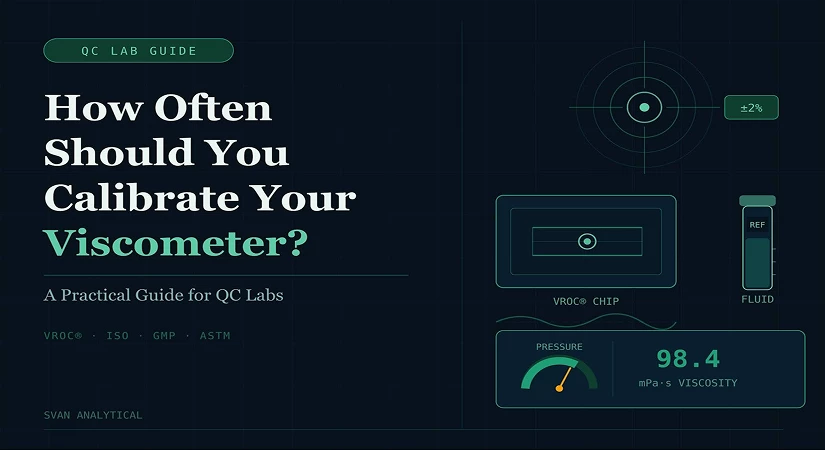
The process of calibration involves measuring a certified reference fluid with a known viscosity value. The instrument’s measured result should fall within approximately ±2% of this reference.
This confirms that the pressure sensor, microfluidic channel, and flow dynamics inside the chip are behaving as intended. When deviations exceed the acceptable tolerance, the instrument may need cleaning, additional diagnostics, or in some cases, chip replacement.
Although VROC® systems are engineered with extremely tight tolerances, several factors can gradually influence accuracy. Pressure sensors can drift slightly over long periods of use, especially under heavy sample loads or challenging operating conditions.
Residue from samples may build up in the microchannel if cleaning is not performed thoroughly, and while the channel itself is robust, repeated exposure to aggressive chemical matrices can affect flow properties. These small changes accumulate over time and make periodic calibration essential for preserving measurement fidelity.
In short, calibration acts as a verification checkpoint—a quality assurance step that ensures the data you generate today remains as reliable as the data you generated last month or last year.

hts-VROC® RehoSense High Temperature Viscosity Viscometer
Five Factors That Determine Your Calibration Frequency
1) Regulatory Environment
For many laboratories, especially those in pharmaceutical, biotechnology, food manufacturing, petroleum, and specialty chemicals, regulatory requirements play the defining role in how often equipment must be calibrated. These industries are governed by strict standards designed to ensure product safety, consistency, and traceability. Calibration frequency, documentation format, and calibration method are often explicitly outlined or expected to align with best practices.
Pharmaceutical QC labs operating under Good Manufacturing Practices (GMP) generally require viscometers to be calibrated at predefined intervals, sometimes quarterly or biannually, depending on risk assessments and audit histories.
Food and beverage manufacturers following FDA guidelines must ensure that instruments used in quality decisions are regularly verified and traceable to certified standards. ISO-driven industries often require documented calibration schedules based on internal quality management plans, while ASTM-regulated petroleum labs depend on strict adherence to standard methods.
In heavily regulated industries, calibration is as much about compliance as it is about accuracy. Failure to calibrate according to a defined schedule can raise significant issues during audits. For such labs, the calibration interval is not flexible, the regulatory framework dictates it. Therefore, the first and most important rule is to follow your industry’s specific regulatory guidelines before considering any other factor.
2) Measurement Frequency & Sample Volume
The amount of work your viscometer performs is a direct indicator of how frequently it should be calibrated. Instruments that operate continuously or measure large batches each day are exposed to greater operational stress. Even in microfluidic viscometry, where there are no moving mechanical parts, repeated sample loading can influence the state of the microchannel and pressure sensor.
For example, a laboratory running 50 or more samples per day will naturally exert far more load on the system than a lab running only a handful of samples weekly. Frequent use increases the potential for residue buildup and accelerates the rate at which sensors experience natural drift. Laboratories that operate multiple shifts, handle high-volume production samples, or perform viscosity measurements as part of in-process control are especially advised to consider shorter calibration intervals.
Instruments that are lightly used may not experience the same wear patterns. However, long periods of inactivity can lead to drying, crystallization, or unexpected residue formation if cleaning cycles are not carefully managed. In both high-use and low-use environments, calibration ensures the system remains aligned, consistent, and trustworthy.
Overall, heavy usage increases the pace at which small deviations can occur. Therefore, labs with high workloads should plan for more frequent calibration to maintain the same level of data confidence.
3) Sample Aggressiveness
Not all samples have the same effect on an instrument. Certain materials, especially those containing harsh solvents, surfactants, acids, or biological components can cause changes to the microfluidic channel or sensor environment. Even if the system is cleaned thoroughly between runs, these samples may leave microscopic residues or interact chemically with the channel walls through repeated exposure.
Examples Of Aggressive Sample Types Include:
- Inks and pigment-based formulations
- Surfactant-rich emulsions
- Biological matrices such as cell lysates, protein solutions, or polymer-rich fluids
- Heavy oils, crude oils, and petroleum derivatives
These sample types can create deposits, alter flow characteristics, or exert chemical stress that gradually affects how accurately the pressure sensor interprets the flow profile. Laboratories working with challenging formulations should implement a shorter calibration frequency to compensate for the higher risk of drift.
In contrast, users who measure simple, aqueous, or low-viscosity clear samples may not need to calibrate as frequently, provided their cleaning procedures are consistent and thorough. Nevertheless, even “simple” sample matrices can cause issues if the cleaning process is incomplete or irregular. When assessing calibration needs, consider the aggressiveness of your sample portfolio as a major contributing factor.
4) After Any Chip Replacement Or Maintenance
The measurement chip in a VROC® viscometer is central to the accuracy of the system. It contains the microfluidic channel and interacts directly with the pressure sensor. Whenever a chip is replaced, whether due to wear, contamination, clogging, or routine maintenance, it must be recalibrated without exception.
A new chip behaves like a new measurement system. Even though VROC® chips are manufactured with high uniformity, every individual chip has slight variations that must be validated through calibration before routine use. Neglecting calibration after chip replacement introduces considerable risk, as the instrument will produce data that cannot be traced to a confirmed performance baseline.
Similarly, if the instrument undergoes maintenance, such as internal cleaning, sensor servicing, or replacement of auxiliary components, calibration ensures that the system’s measurement integrity is fully restored. This step verifies that the device is ready for precise, repeatable analysis again.
5) After Environmental Disruptions
Environmental stability plays a surprisingly important role in measurement accuracy. Changes in temperature, humidity, vibration exposure, or physical positioning can introduce subtle variations in pressure sensor behavior or internal flow dynamics. Even though VROC® viscometers are engineered to be robust, they are still precision instruments.
Environmental disruptions may include instrument relocation, transport across facilities, accidental impact, or abrupt power interruptions, particularly during active measurement runs. Portable devices such as microVISC™, designed to be moved frequently, are particularly susceptible to small shifts that can influence calibration integrity.
After any such event, recalibration acts as a safeguard. It verifies that external disturbances have not altered the internal measurement environment and that the instrument’s performance remains stable before further samples are analyzed.

How Often Should You Calibrate Your Viscometer?
After considering all influencing factors such as regulatory expectations, workload, sample chemistry, maintenance practices, and environmental stability, the core question remains: How frequently should a viscometer actually be calibrated? While there is no universal interval that applies to every laboratory, the following guidelines offer a practical and well-reasoned starting point.
1. Regulated Quality-Control Labs
Highly regulated QC environments such as pharmaceutical, biotech, and food testing labs, follow fixed, audit-ready schedules. Calibration frequencies typically include:
- Quarterly (every 3 months)
- Biannually (every 6 months)
- Annually, only for low-risk instruments maintained under exceptional environmental stability
These intervals are shaped by risk assessments, audit preparedness, and historical calibration consistency. Instruments used for batch release or regulatory submissions usually require tighter schedules to ensure unquestionable traceability.
2) High-Throughput Laboratories
Labs processing large numbers of samples or supporting continuous production cycles experience faster instrument wear and measurement drift. Common calibration intervals include:
- Monthly
- Every 6–8 weeks
- After a set number of analyses (e.g., every 1,000 samples)
Higher sample volume introduces cumulative stress on the viscometer, making shorter intervals essential for maintaining accuracy and avoiding QC failures.
3) Laboratories Handling Aggressive Or Complex Samples
Certain matrices such as crude oils, emulsions, inks, polymer solutions, and biological fluids can interact with internal components or leave persistent residues. Recommended intervals include:
- Every 1–2 months
- After intensive or high-viscosity testing campaigns
These schedules minimize the risk that buildup, corrosion, or chemical interactions have altered flow paths or sensor sensitivity.
4) Low-Throughput Or Research Environments
R&D labs, academic facilities, and low-use environments may not require frequent calibration. Typical schedules include:
- Twice per year
- Annually, provided the instrument shows strong stability trends
However, low usage does not eliminate the need for verification. Labs should still perform intermediate checks using certified reference fluids to catch unnoticed drifts between formal calibrations.
5) Event-Based Calibration Triggers
Certain events should immediately prompt calibration, regardless of the existing schedule. These include:
- Chip replacement
- Major cleaning or internal maintenance
- Instrument relocation or mechanical shock
- Power interruptions or system errors during a run
Event-driven recalibrations safeguard against sudden, unexpected deviations that routine schedules cannot anticipate.
Recommended Calibration Schedule By Industry:

Svan Analytical offers seamless local service coordination for RheoSense instruments, ensuring your lab stays efficient, compliant, and worry-free. Connect with us to craft a service plan perfectly aligned with your operational demands and regulatory needs!
In Conclusion
Calibration is the foundation of reliable viscosity measurement and quality control. While the question “How often should I calibrate my viscometer?” seems straightforward, the answer depends on a combination of regulatory, operational, and environmental factors.
Laboratories must consider their compliance requirements, sample workload, material types, maintenance cycles, and overall operating conditions to determine an appropriate calibration schedule.
VROC® viscometers, with their microfluidic precision and sensor-driven measurement design, provide highly stable and accurate results but like all analytical instruments, they require periodic verification to maintain that performance.
A well-planned calibration strategy ensures measurement accuracy, protects product quality, supports regulatory compliance, and preserves the credibility of your laboratory data.
If your lab needs assistance in designing the right calibration and maintenance plan, Svan Analytical provides localized support for RheoSense instruments.
We can help you develop a calibrated schedule tailored to your operational intensity, regulatory obligations, and sample challenges, ensuring your viscometer remains accurate, efficient, and ready for every measurement you rely on.
FAQs
1) How Often Should I Calibrate My Viscometer?
Calibration frequency depends on your laboratory’s workload and regulatory environment. Highly regulated QC labs typically calibrate their instruments quarterly or biannually, while high-throughput labs may require monthly verification due to heavier usage. Research or low-use environments can often calibrate semi-annually or annually, as long as the instrument demonstrates stable performance. Adding routine reference checks between major calibrations can further strengthen confidence in day-to-day data.
2) What Triggers An Immediate Calibration Outside The Regular Schedule?
Certain events require recalibration even if you are not due for a scheduled check. These include chip replacement, major maintenance or internal cleaning, relocation or mechanical impact, and unexpected power interruptions during a measurement run. Any of these disruptions can affect internal components and must be verified before the instrument is used again. Prompt recalibration ensures that any sudden changes are caught before they impact critical QC decisions.
3) Why Is Calibration Important For VROC® Viscometers?
Calibration confirms that the microfluidic channel and pressure sensor are functioning within the expected accuracy range. This ensures every viscosity measurement is trustworthy, protects quality-control decisions, prevents data drift, and supports compliance with regulatory standards. Regular calibration ultimately safeguards product quality and maintains confidence in your laboratory data. By keeping the instrument aligned to certified standards, you reduce the risk of costly rework or batch failures.