Article
Cleanroom Equipment Lifecycle: From Installation To Validation
Feb 17, 2026
Enoch Daniel
Director
A cleanroom is the heartbeat of any contamination-controlled environment, whether in pharmaceutical manufacturing, biotechnology, microelectronics, or advanced research laboratories. It is not just the physical space that matters, but the equipment within it and the lifecycle management that ensures consistent contamination control. The lifecycle of cleanroom equipment spans from initial planning and installation to rigorous validation, continuous monitoring, and periodic requalification.
Understanding this lifecycle is crucial for quality assurance teams, facility managers, engineers, and regulatory professionals who must ensure compliance with ISO 14644, GMP guidelines, and other industry-specific regulations.
What Is Cleanroom Equipment and Why It Matters
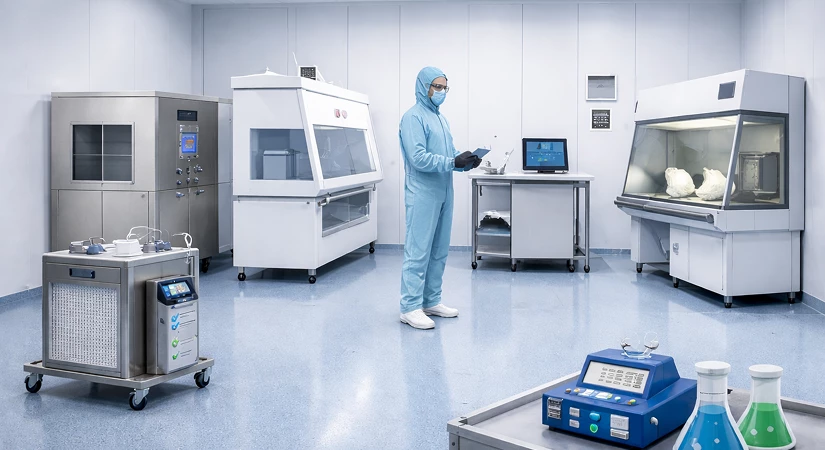
Cleanroom equipment includes specialised devices engineered to control particulate, microbial, and environmental contaminants. Common equipment categories include:
- Air Handling Units (AHUs) and HVAC systems with HEPA or ULPA filtration
- Laminar Flow Cabinets and Workstations
- Containment Isolators and Pass-Throughs
- Environmental Monitoring Devices (particle counters, microbial samplers)
- Decontamination Systems, such as UV units and vaporised hydrogen peroxide generators
- Glove Leak Testers and Transfer Bag Systems for aseptic material handling
These components help maintain cleanroom classifications defined under ISO 14644-1, ensuring that the environment supports sensitive manufacturing or testing processes.
The Lifecycle of Cleanroom Equipment: A Detailed View
1. Procurement and Pre-Installation Planning
The lifecycle of cleanroom equipment begins long before hardware is delivered to the site. This phase defines the User Requirement Specifications (URS), the foundation for all downstream activities.
Key tasks include:
- Detailed needs assessment based on the products or processes supported
- Identification of cleanroom class requirements (ISO 5–ISO 9)
- Selection of equipment that meets strict environmental performance and regulatory compliance
During this phase, teams collaborate with vendors, such as those featured in the Svan cleanroom product range, to ensure that equipment capabilities align precisely with contamination control needs.
A comprehensive URS will include performance criteria, spatial constraints, utility requirements, and integration with building management and HVAC systems.
2. Installation and Factory Acceptance
Once equipment is selected and purchased, it undergoes pre-installation checks and, where applicable, Factory Acceptance Testing (FAT). This step ensures that critical specifications are met before shipment.
Upon arrival at the facility, the cleanroom equipment is installed in accordance with the design specifications. Essential elements during installation include:
- Site layout adherence to approved engineering drawings
- Utility connection checks (power, compressed air, gases)
- Initial calibration of sensors and control systems
- Physical placement that matches airflow designs without interference
After installation, Site Acceptance Testing (SAT) is performed to verify that the equipment was not damaged during transit and is ready for operational qualification.
3. Qualification: IQ, OQ, PQ — The Validation Trilogy
Cleanroom equipment validation is the cornerstone of ensuring the environment performs reliably under real-world conditions. This process moves through three key qualification phases.
a. Installation Qualification (IQ)
Installation Qualification confirms that each piece of equipment has been installed correctly and in accordance with the design and manufacturer specifications. The IQ process includes:
- Verification of equipment placement and mechanical integrity
- Utility and electrical checks
- Calibration validation of monitoring instruments
- Confirmation of filter installations (HEPA/ULPA)
The cleanroom’s core HVAC systems and instruments are verified to ensure they are in readiness for performance testing.
Deliverables: IQ Protocols, As-built drawings, calibration certificates, and installation deviation reports.
b. Operational Qualification (OQ)
Operational Qualification goes beyond installation and testing; it ensures equipment performance under specified conditions. It is during OQ that cleanroom systems are scrutinised for consistent behaviour, such as:
- Air velocity and airflow uniformity
- Pressure differentials between adjacent zones
- Temperature and humidity control mapping
- Alarm and interlock functionality
This phase will often include tracer studies, smoke visualisation, and high-precision particle counts. The aim is to confirm that parameters remain within allowable ranges under static and defined dynamic conditions.
Deliverables: OQ reports, deviation logs, operational verification data
c. Performance Qualification (PQ)
The most critical stage of validation, Performance Qualification, demonstrates that all cleanroom systems, including the installed equipment, perform as intended under actual operating conditions. Unlike OQ, PQ tests the system under normal workload, with operational personnel and material flow.
Critical checks include:
- Dynamic particulate counts
- Viable microbial air and surface sampling
- Long-term stability of temperature, humidity and pressure
- Recovery time tests after door openings
PQ results are statistically analysed to show repeatability and compliance with ISO classifications.
Deliverables: Final PQ reports, certification documentation, validation summary
4. Certification and Compliance Documentation
After successful qualification, cleanroom certification is issued in accordance with international standards, such as ISO 14644-1. Certification is not a one-time event; it must be maintained through periodic requalification and ongoing monitoring. This documentation is critical for regulatory inspections, quality audits, and demonstrating compliance across industry standards.
Certification typically includes:
- ISO class certification
- HEPA/ULPA filter integrity test results
- HVAC performance certification
- Environmental monitoring data
5. Ongoing Monitoring and Requalification
Cleanroom environments are dynamic. Even slight changes in production, personnel traffic, or environmental controls can impact contamination levels. Hence, ongoing monitoring and periodic revalidation are essential. Regular activities include:
- Daily and weekly particle count logging
- Microbial monitoring (settle plates, swabs)
- Differential pressure checks
- Annual or semi-annual IQ/OQ/PQ requalification cycles
Any significant changes to cleanroom layout, equipment, or process require a new round of revalidation to ensure the controlled environment continues to meet specifications.
Beyond Validation: Maintenance and Lifecycle Support
Longevity and reliability depend on routine maintenance and lifecycle support strategies. Manufacturers and service providers often offer:
- Training for operations and maintenance teams
- Preventive maintenance schedules
- Calibration services for monitoring instruments
- Spare parts planning and logistic support
Such services help maximise uptime and ensure that cleanrooms and their equipment remain compliant and efficient throughout their service life.
FAQs
1. What are the main phases of cleanroom equipment validation?
Cleanroom validation encompasses Installation Qualification (IQ), Operational Qualification (OQ), and Performance Qualification (PQ), each verifying the correct installation, operational readiness, and consistent performance under real-world conditions.
2. Why is cleanroom validation needed?
Validation ensures that the facility and equipment meet the designed performance requirements and regulatory standards, safeguarding product quality and compliance.
3. How often should a cleanroom be requalified?
Cleanrooms are typically requalified annually or after significant modifications to systems, processes, or equipment to ensure continued regulatory compliance.
4. What standards govern cleanroom classification?
ISO 14644-1 defines cleanroom classes based on allowable particle counts within specified size ranges, guiding design and validation requirements.
5. What role does HVAC play in cleanroom performance?
The HVAC system, including HEPA/ULPA filtration and pressure control, is crucial for maintaining cleanroom environmental parameters, such as airflow, temperature, humidity, and particle control.